 Download slides
Policy and trade shifts reshape cross-border freight
Published: Thursday, January 08, 2026 | 12:00 AM CDT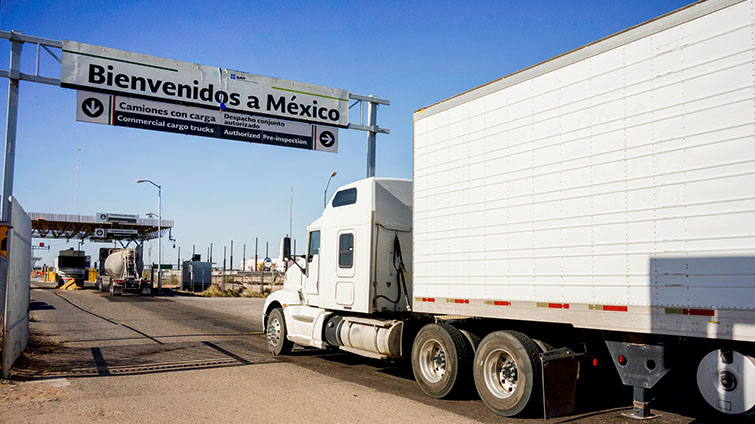
U.S.–Mexico
Cross-border freight between the United States and Mexico entered the end of the year with strong exports but constrained by automotive weakness and policy risk.
Overall Mexican exports rose 7.9% in November—the latest data available. That marked six consecutive months of export growth, driven primarily by manufactured goods such as electronics. In contrast, Mexico’s automotive production contracted 8.4% in November and vehicle exports declined 3.4%. Prolonged uncertainty, production stoppages, and operational disruptions limited the automotive sector’s recovery and are expected to weigh on volumes into early 2026.
For carriers and shippers, this divergence translated into uneven demand and reduced predictability. Strong non-auto exports helped sustain cross-border flows, but weaker automotive volumes led to instability in truck utilization and rates. Seasonal plant shutdowns and highway blockades late in the year compounded the situation.
Carriers reported near-zero freight growth in their businesses in 2025. While not viewed as a crisis, the year is widely seen as a warning sign that carrier closures could lie ahead. Rates are expected to be stable to start 2026.
For 2026, economists forecast ~1.6% GDP growth for Mexico, signaling a moderate recovery from near zero GDP growth in 2025. This was supported by exports and nearshoring, though trade policy clarity and investment confidence will remain critical to restoring freight momentum.
Mexican government approves tariffs on China
Looking ahead, Mexico’s tariffs on Asian imports, particularly from China, add another layer of uncertainty. New and higher tariffs went into effect January 1, 2026. Approximately 44% of Mexican imports come from Asian countries impacted by the tariffs, more than the 38% of imports Mexico gets from the United States and Canada. The tariffs range from 5% to 50% on auto parts, steel, aluminum, and plastics as well as goods such as furniture, footwear, and appliances.
Affecting $51.9 billion in trade, the tariffs could reshape sourcing strategies over time. Near-term they pose risks for manufacturers, given that 77% of imports into Mexico are intermediate inputs that go into finished products for export. For manufacturing inputs not available locally or not available in enough quantity locally, this could raise costs and disrupt supply chains for years.
U.S.–Canada
CARM customs portal still plagued by technical problems
More than a year after its launch, Canada’s new CARM customs portal continues to generate significant operational challenges for shippers and carriers. Persistent system outages and technical issues are contributing to shipment backlogs, increased administrative workload, and longer transit times for cross-border freight. Foreign importers are reportedly experiencing delays of up to two months to complete portal registration, further complicating trade flows.
Despite these challenges, Canada posted a $153 million merchandise trade surplus in September (the most recent data available from the Canadian government due to U.S. Census Bureau delays). The first trade surplus since January, it was driven by an increase in exports in excess of 6% alongside a 4.1% decline in imports.
In early 2026, export activity may soften slightly before a more sustained recovery later in the year. Overall freight volumes, however, are expected to remain supported by robust U.S. demand and shipments tied to commodity markets.
Truckload market
Similar to the U.S. truckload market, the Canadian market saw some weather and seasonal-related pressure to close the year. But macro trends kept negative pressure on rates through November and early December. Particularly on cross-border lanes, slower retail restocking and subdued manufacturing activity kept volumes muted while capacity stayed readily available—creating a stable, low-volatility environment rather than a traditional peak-season surge.
For Q1, freight volumes are expected to be relatively stable, supported by continued cross‑border demand and commodity-driven shipments, though seasonal winter impacts will likely create pockets of localized disruption.
Weather impacts
Cold temperatures, snowstorms, and ice-related road closures can slow trucking operations and extend transit times, particularly in central and eastern Canada. Rail carriers are implementing winter operating plans, including shorter trains and adjusted schedules, which may add 12–24 hours to transit on some lanes. While these seasonal challenges are typical, they reinforce the importance of proactive planning, flexible routing, and early booking to maintain service reliability and mitigate cost fluctuations.